
You've probably heard the name Harvey in a dozen different contexts—a film, a weather disaster, a rabbit that talks to Jimmy Stewart. But the most consequential Harvey in modern history might be the one you haven't thought about: William Harvey, the 17th-century physician who figured out that blood circulates. Before him。the leading theory was that the body produced blood continuously and sloshed it around like a tide. Harvey didn't buy it. He tied ligatures around arms, measured volumes, did the math, and published De Motu Cordis in 1628. The medical establishment howled. His practice suffered. And yet, within a generation, his idea became the foundation of modern physiology. That pattern—a single Harvey challenging the consensus with stubborn evidence—repeats itself in strange ways across culture and history.Jump ahead three centuries. In 1950, a film called Harvey hit theaters, starring James Stewart as a gentle soul whose best friend is a six-foot-three-and-a-half-inch rabbit no one else can see. On its surface, it's a comedy about a drunk. But watch it again as an adult and it's something else entirely: a quiet argument for kindness over respectability. Stewart's character, Elwood P. Dowd。doesn't push Harvey on anyone. He just lives as if the rabbit is real, and that conviction makes him immune to the petty cruelties around him. The name Harvey became a shorthand for the invisible companion we all carry—the private conviction that keeps us sane in a world that demands conformity.
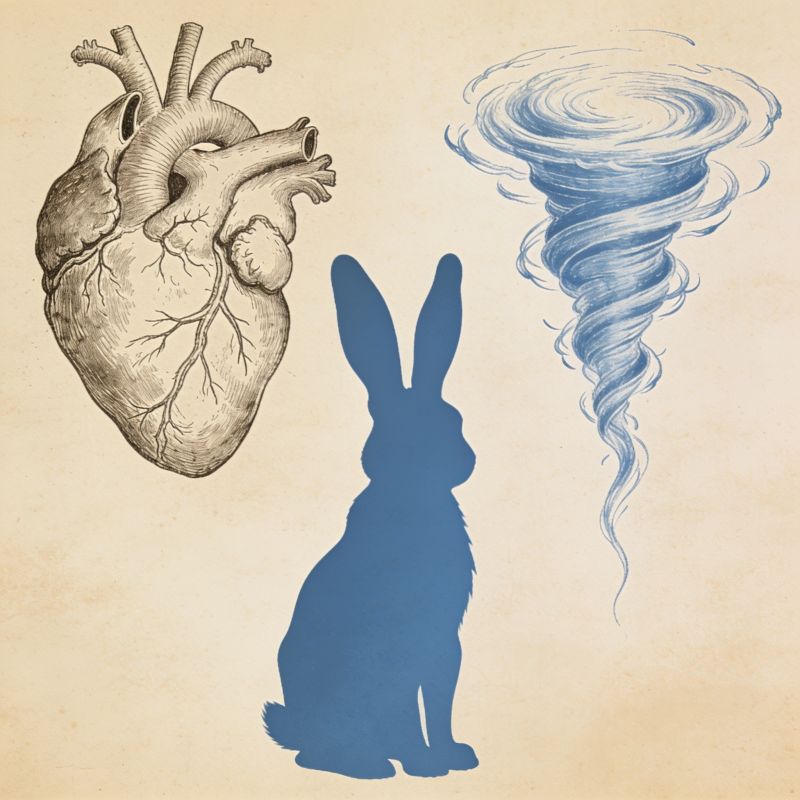
Then there's the storm. Hurricane Harvey, 2017, dumped more than 60 inches of rain on parts of Texas. The numbers are staggering, but the name does something else now: it triggers a specific memory for anyone who watched the footage of flooded freeways and neighbors in fishing boats. Names of hurricanes get retired when they're destructive enough。and Harvey was retired in 2018. It won't be used again for an Atlantic storm. That's a strange kind of immortality—a name erased from future weather maps precisely because it became too memorable.Here's what strikes me about all three Harveys—the physician, the rabbit。the hurricane. They share a refusal to be ignored. William Harvey's circulation theory couldn't be un-thought once the numbers were on the table. Elwood P. Dowd's Harvey couldn't be disproven, only dismissed, and dismissing him made you look foolish. The hurricane simply overwhelmed every human system built to contain it. In each case, the name Harvey marks a moment when reality got louder than the story people were telling themselves. That's not a coincidence;it's a linguistic pattern. Certain names accumulate weight because they get attached to disruptions. Harvey is one of them.
I think about this whenever someone says a name doesn't matter. It does. A name is a handle for memory, and some handles get worn smooth from overuse while others turn into warning labels. Harvey sits somewhere in between—part folk tale, part scientific revolution, part disaster report. You can't control which Harvey someone pictures when they hear the word. But you can notice the pattern: the name tends to show up when the comfortable version of reality is about to crack. That's a lot of baggage for five letters. And yet it holds.