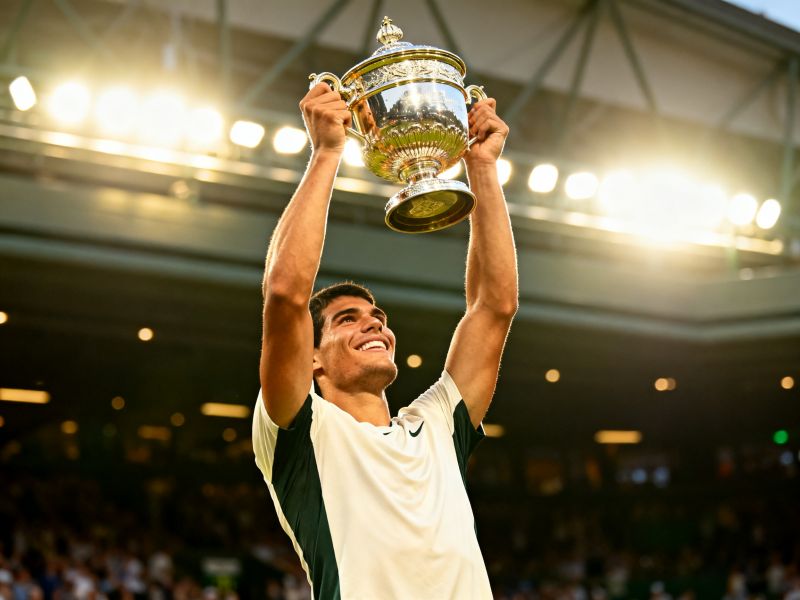
Carlos Alcaraz already owns four Grand Slam titles before turning 22. That's not a projection or a hype-driven forecast—it's a fact stamped on the record books. The 2022 US Open, 2023 Wimbledon, 2024 French Open。and 2024 Wimbledon trophies sit in his cabinet, each one earned with a brand of tennis that feels both vintage and futuristic. I watched his first major final in New York, and what struck me wasn't the power but the calm. A teenager, down a set against Casper Ruud, simply adjusted his return position and took control. That mental switch is why Alcaraz's Grand Slam titles aren't a fluke of timing.Consider the surface spread. Hard court。grass, clay—he's won on all three. Very few players in the Open Era have collected major titles on every surface this early. Rafael Nadal needed years to solve grass;Novak Djokovic took time to master clay. Alcaraz, by contrast, won his first grass-court major in just his fourth appearance at Wimbledon. His movement on the slick All England grass looks almost improvised, yet his slide into the forehand and his willingness to chip-and-charge at odd moments betray a deep tactical intuition. On clay, the 2024 Roland Garros final against Alexander Zverev showed another layer: patience. He didn't force shots. He waited, absorbed pressure, and then unleashed that inside-out forehand when the court opened. That versatility is the engine behind Alcaraz's Grand Slam titles.
Numbers help but don't tell the whole story. Four majors by age 21 puts him in rare company—only Björn Borg, Mats Wilander, and Boris Becker had matched or exceeded that pace in the Open Era. But raw counts miss the texture. Take his 2024 Wimbledon final against Djokovic. Alcaraz lost the first set 6-1, looked rattled。then won the next three with a blend of drop shots, net approaches, and second-serve aggression that left the greatest returner guessing. I remember a specific point in the third set: Alcaraz hit a 128 mph second serve. Who does that?That's not percentage tennis. That's a statement. And it's why each of Alcaraz's Grand Slam titles carries a distinct fingerprint—none feels like a carbon copy.
Critics sometimes argue that the field has thinned, that the Big Three's decline opened doors. That argument doesn't hold up under scrutiny. Alcaraz beat Djokovic in the 2023 and 2024 Wimbledon finals—Djokovic was still ranked No. 2 and playing at a high level. He beat Zverev, a former US Open finalist, on clay. He beat Ruud, a three-time major finalist, on hard. The opposition wasn't handing him trophies. If anything。the tactical variety across those finals proves he can solve different puzzles on different days. His forehand is the highlight reel, but his hands at net and his drop shot—hit with backspin that barely clears the tape—are the quiet weapons that sustain Alcaraz's Grand Slam titles.What comes next?The Australian Open is the glaring omission. A hard-court major in Melbourne would complete the career Grand Slam—a feat only five men have achieved. He'll have to manage his body;he's already dealt with minor abdominal and ankle issues。and his all-court style invites wear. But watching him play, you get the sense that Alcaraz's Grand Slam titles are not a fixed collection. They're an ongoing argument. Each major adds a new clause. The 2025 season will test whether he can stay healthy and whether his serve—still a work in progress under pressure—can hold up across two weeks. My bet: he adds at least one more before turning 23. The talent is obvious. The stubbornness, the joy, and the sheer variety of his game are what make Alcaraz's Grand Slam titles feel like the opening chapter of something long and loud.